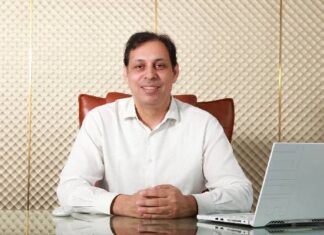




















In an exclusive interview, Anuj Chahal, Founder & CEO, Maverick Simulation Solutions, shares insights on the company’s innovation and scaling up strategy, upcoming initiatives and future outlook.
 What inspired you to establish Maverick Simulation Solutions, and what gap in the market are you aiming to address?
The idea behind Maverick Simulation Solutions was born out of a very simple observation: that while healthcare education in India produces some of the most skilled and compassionate doctors in the world, the means to train them are often outdated. As engineers and healthcare enthusiasts, we realized that medical students were learning life-saving procedures largely through theoretical methods with limited real-world exposure. This gap between knowledge and hands-on experience inspired us to act. We wanted to create a bridge, one that allowed students, doctors, and paramedics to practice without fear before facing real patients. That’s how Maverick Simulation Solutions came to life. Our mission was not just to make high-fidelity simulators accessible but to make them affordable, localized, and contextual to Indian medical needs. We aimed to reduce dependency on imported technologies and establish India as a global hub for simulation-based medical education, a true “Make in India” initiative that solves a global problem.
What has been the journey of scaling up from a bootstrapped start-up to becoming a Make in India med-tech company with global ambitions?
The journey has been both challenging and deeply rewarding. We started with a small core team, a handful of engineers and doctors with a clear vision: to create indigenous medical simulators that meet international standards. In the early days, we faced typical start-up hurdles: limited resources, scepticism from institutions, and the daunting task of developing highly complex products from scratch.
But what kept us going was belief – belief in the idea that India could design and manufacture its own advanced simulation technology which will be accepted globally as well. We partnered closely with specialised doctors, educators, and biomedical experts to understand the real pain points of medical training. This collaboration became our backbone.
From our first prototype to now having an expanding product portfolio that covers simulators for basic motor skills like injection trainer,suturing, airway management to the rarest procedures like anaesthesia, cardiology, and emergency care, every step has been a learning curve. Today, being recognized as one and only one Make in India med-tech companies with global ambitions validates years of perseverance and innovation. We’ve grown from a small R&D setup to a scalable ecosystem where hardware, software, and AI intersect to create life-like simulation experiences, proudly Make in India, for the world.
“The company’s investment will surely be a milestone in our growth journey and a strong vote of confidence in India’s potential to lead med-tech innovation.”
How is a Rs 50 crore investment fueling the development of AI, AR, and VR-based simulators in India’s med-tech R&D space?
The company intended to invest Rs 50 crore in phases and it will surely be a milestone in our growth journey and a strong vote of confidence in India’s potential to lead med-tech innovation. This phase wise funding will primarily fuel three key areas: R&D acceleration, AI integration, and immersive learning ecosystems.
First, it allows us to strengthen our R&D infrastructure – building next-generation labs where engineers, clinicians, and data scientists work together on simulation intelligence. Second, it’s enabling us to integrate Artificial Intelligence, Augmented Reality, and Virtual Reality into our simulators. With these technologies, users can experience near-real clinical situations, guided by AI-driven feedback that improves skill retention.
Finally, part of this investment is directed toward scaling manufacturing and ensuring that our products are not only technologically advanced but also cost-effective for Tier-II and Tier-III institutions. The goal is to democratize access – to make advanced simulation no longer a luxury but a necessity in every medical college, hospital, and training centre across India.
What factors are driving the rapid adoption of simulation technologies in Tier-II and Tier-III cities, and how is this expansion influencing equitable access to medical education?
Several factors are converging to accelerate adoption in smaller cities. First, the National Medical Commission’s emphasis on skill-based learning has made simulation labs an essential infrastructure for medical institutions. Second, the pandemic underscored the importance of contactless yet realistic training environments. Third, there’s a generational shift: students today are digital natives who learn better through experiential and interactive methods.
Our experience has shown that institutions in Tier-II and Tier-III cities are incredibly forward-looking. They understand that to retain talent and raise educational standards, they need access to the same quality of tools available in metros. This awareness, combined with our “Make in India” cost advantage, has made simulation adoption far more attainable.
The result is a more equitable ecosystem, where a student in Ranchi, Guwahati, or Coimbatore can train on the same advanced simulators as one in Delhi or Mumbai. That’s transformative because it ensures that quality healthcare begins not in the hospital but in the classroom, everywhere.
In what ways are collaborations with AIIMS and IITs helping to build a world-class simulation ecosystem in India that can also serve global needs?
Collaboration is at the heart of innovation. Our partnerships with institutions like AIIMS, IITs, and many other renowned institutions are not just about joint projects, they represent a shared vision to elevate India’s technological and medical capabilities.
With AIIMS, we work closely on clinical validation and curriculum integration to ensure that our simulators align with real-world medical training requirements. With IITs, we collaborate on mechatronics, AI algorithms, and immersive interfaces to bring precision and realism into every model.
Together, these collaborations are creating a simulation ecosystem that combines India’s strengths in medicine, engineering, and research. It’s an ecosystem that not only serves domestic institutions but also positions India as an exporter of simulation technology to emerging healthcare systems across Asia, Africa, and beyond.
“With AIIMS, we work closely on clinical validation and curriculum integration to ensure that our simulators align with real-world medical training requirements.”