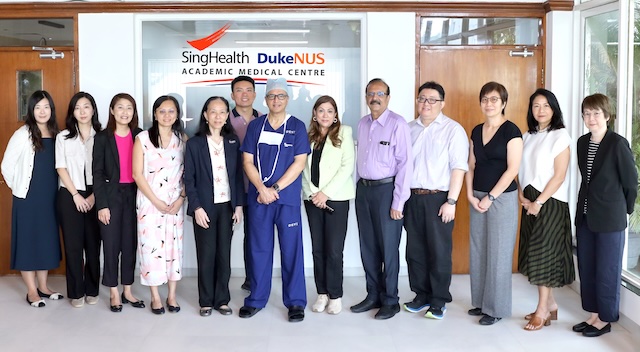
New Delhi: Through a new postgraduate programme Executive Master in Healthcare Leadership and Management, the SingHealth Duke-NUS Global Health Institute is deepening cross-border collaboration with India through its Asian Institute for Healthcare Leadershipand Management (Asian HEAL) to strengthen regional leadership capacity and prepare senior healthcare professionals to drive transformation acrossAsia’s health systems.
This partnership draws on leading expertise from across the region, including distinguished Indian healthcare leaders such as Dr Devi Prasad Shetty, Chairman, Narayana Health, and Dr N. Venkatesh Prajna, Chief, Cornea and Refractive Surgery Services, Aravind Eye Hospital. Both have pioneered some of Asia’smost impactful innovations in delivering affordable, high-quality, and sustainable care.
A milestone in Singapore-India collaboration
The Executive Master’s programme represents a first-of-its-kind collaboration between Singapore and India, combining Singapore’s governance capabilitieswith India’s expertise in affordable care delivery innovations. Its curriculum is grounded on regional perspectives, with the 15-month, part- time programme beginning in Singapore and featuring immersive site visits to India as well as Thailand and the Philippines.
The syllabus underscores the value of Asian-led solutions to manage Asian healthcare challenges. By drawing lessons from Asian-led models rather thanWestern frameworks, the programme equips leaders to navigate the region’s unique social, economic, and infrastructural realities. This approach also fills a criticalgap: acknowledging that Asia’s diverse population densities, resource limitations, and cultural contexts demand solutions designed from within.
“Asia’s healthcare challenges cannot be solved by importing models, they must be shaped by leaders who understand the realities on the ground. AsianHEAL offers a powerful platform for us to share what has worked in India and learn from our neighbours, so that together we can build systems that are efficient,compassionate, and designed for scale. This collaboration marks an important step toward creating the next generation of healthcare leaders for our region,”explains Dr Shetty.
Real-world impact through practitioner-led learning
The Executive Master’s programme focuses on experiential learning through real-world case studies, site visits, and interactions with practicing faculty acrossAsia. The curriculum covers strategic management, innovation, operations, and systems thinking, empowering professionals to translate leadership theory intopracticum.
Through Dr Shetty and Dr Prajna’s participation as teaching faculty, participants gain direct insights into India’s transformative healthcare models, including Narayana Health’s community-based cardiac care and Aravind Eye Care’s scale-driven, high-volume approach. These models are highly relevant lessons onhow technology, operational design, and data-driven management can expand access and improve outcomes, even under resource constraints.
Underscoring the value in the cross exchange in learning, Dr Prajna points out, “Collaboration is at the heart of sustainable healthcare transformation. Through Asian HEAL, we have a unique opportunity to engage deeply with peers across Asia, exchange practical insights, and collectively reimagine howcare can be delivered more effectively. When regional expertise comes together in this way, it creates lasting impact for both practitioners and the patients weserve.”
A unique part of the programme in India will be a fireside chat with Dr Prajna and Dr Paul Salins, Senior Maxillo Facial Surgeon and Director of Mazumdar Shaw Medical Foundation, which will enable participants to lean into their insights on how collaboration across borders can inspire practical innovation.
The dialogue, titled “Strategic Innovations for Future Healthcare”, will explore the ways in which technology, leadership, and cross-sector collaboration are redefining hospital operations and patient care in the region.
“Dialogues like the fireside chat are important in highlighting the lived experiences of healthcare practitioners. These conversations offer invaluable insights from those who have successfully navigated change within complex health systems. By grounding our teaching in real-world practice, we empower participants to translate leadership principles into measurable systems transformation that can directly improve patient care and outcomes across theregion,” shares Professor Ong Biauw Chi, Course Director of the Executive Master’s Programme, who is also Chief Risk Officer, SingHealth.
By synergising Singapore’s systems excellence with India’s spirit of innovation, the Executive Master in Healthcare Leadership C Management programme is poised to leverage collaborations in healthcare leadership in Asia to empower professionals to build stronger, more equitable, and future-ready health systems.