




























Government, regulatory and industry leaders called for deeper domestic manufacturing, stronger innovation capabilities and greater integration with global medical-device value chains as the ninth India Medical Device conference opened in New Delhi.
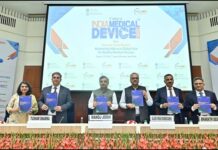
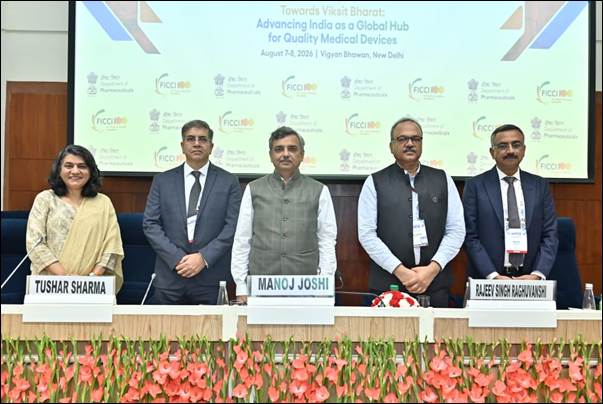
The ninth edition of India Medical Device 2026 opened at Vigyan Bhawan in New Delhi on Friday, with policymakers, regulators and industry leaders placing export competitiveness, deeper domestic value addition and innovation at the centre of India’s medical-device manufacturing agenda.
The two-day conference, organised by the Department of Pharmaceuticals in association with the Federation of Indian Chambers of Commerce and Industry (FICCI), is being held under the theme, “Towards Viksit Bharat: Advancing India as a Global Hub for Quality Medical Devices.”
Addressing the inaugural session, Manoj Joshi, Secretary, Department of Pharmaceuticals, said the sector needed to be viewed from both healthcare and industrial perspectives. While healthcare providers require access to quality medical devices irrespective of their origin, he said strengthening domestic manufacturing was important for employment generation, industrial capability and supply-chain resilience.
Joshi said India had made progress in local manufacturing of consumables and disposables, as well as in the assembly of higher-end equipment, including diagnostic and imaging systems. He called for greater domestic value addition, stronger component manufacturing, investment in advanced medical technologies and continued improvement in quality standards.
He also argued that India’s strategy should extend beyond import substitution towards building an export-oriented medical-device industry.
According to Joshi, India’s medical-device market is valued at around US$16 billion compared with a global market exceeding US$600 billion. He said stronger domestic component manufacturing, easier cross-border movement of components and products, integration with global value chains and closer collaboration between start-ups and larger companies would be important for expanding India’s presence in international markets.
Dr Rajeev Singh Raghuvanshi, Drugs Controller General of India, highlighted the need to strengthen indigenous capabilities in high-risk Class C and Class D medical devices and in-vitro diagnostics. He also called for regulatory processes that are faster, transparent and predictable as domestic manufacturing capabilities expand.
Tushar Sharma, Chair of the FICCI Medical Devices Committee and Managing Director and General Manager, India and South Asia, Abbott Healthcare, said medical-technology companies had expanded their presence in India across research and development, global capability centres, software and engineering operations, clinical research, manufacturing, service networks and workforce development.
Jyoti Vij, Director General, FICCI, said the sector’s next phase would depend on stronger R&D and innovation, resilient supply chains, advanced manufacturing, internationally aligned quality standards, adoption of digital technologies and a greater presence in overseas markets.
Bharath Sesha, Co-Chair of the FICCI Medical Devices Committee and Managing Director, Philips Indian Subcontinent, also pointed to India’s potential to expand its position in the global medical-device industry.
The inaugural session also saw the release of a white paper on strengthening the service and maintenance ecosystem for medical equipment in India. The document examines the need for stronger systems to improve equipment safety, reliability, longevity and continuity of operation across healthcare facilities.
The conference continues on 8 August with discussions involving government, industry and other stakeholders on manufacturing, regulation, innovation and India’s integration with global MedTech value chains.