





























Ahmedabad: India has achieved an important breakthrough in the history of medical science with the World’s First-in-Human Telerobotic Coronary Intervention by Dr Tejas Patel, Chairman and Chief Interventional Cardiologist of the Apex Heart Institute at Ahmedabad. He used CorPath technology of Corindus Vascular Robotics, to conduct the first-in-human (FIH) telerobotic coronary intervention. This is the world’s First Percutaneous Coronary Intervention (PCI) conducted from a remote location outside of the catherization lab.
The PCI procedure was performed by Dr Tejas Patel from Swaminarayan Akshardham temple, located at a distance of roughly 32 km from catherization lab of the Apex Heart Institute in Ahmedabad, where the patient was admitted and attended to by Dr Sanjay Shah. The success of this study paves the way for large-scale, long-distance telerobotic platforms across the globe. Chief Minister of Gujarat Shri Vijaybhai Rupani, Deputy Chief Minister Shri Nitinbhai Patel along with saints of Bochasanwasi Akshar Purushottam Swaminarayan Sanstha (BAPS) Pujya Shri Brahmavihari Swami and Pujya Shri Ishwarcharan Swami remained present on this occasion.
On this occasion, Dr Tejas Patel, Chairman and Chief Interventional Cardiologist of the Apex Heart Institute, said, “The first-in-human case of remote robotic PCI represents a landmark event for interventional medicine. Cardiovascular diseases, including stroke, are the number one cause of death worldwide resulting in nearly 18 million deaths per year. The application of telerobotics in India has the potential to impact a significant number of lives by providing access to care that may not otherwise have been possible. I am honoured for contributing to this historic groundbreaking research which is going to earn a lot of glory and global respect for my country.”
Telerobotic coronary interventional platform has the potential to dramatically improve patient access for both elective and emergent percutaneous coronary interventions and stroke in rural and underserved populations. It will reduce time to treatment for emergent procedures such as STEMI and stroke and will also reduce variability in operator skills and thus, improve clinical outcomes.
Mark Toland, President and Chief Executive Officer of Corindus, stated, “Cardiovascular diseases, including stroke, are the world’s most significant and undertreated clinical problem due to limited access to specialized, timely medical care. As a result of existing barriers to care, including increased global poverty and a declining number of trained specialists, only a fraction of patients worldwide receives life-saving treatment, resulting in substantial death or disability. We anticipate that our technology will revolutionize cardiovascular disease treatment by providing specialized and timely medical care to anyone, anywhere.”
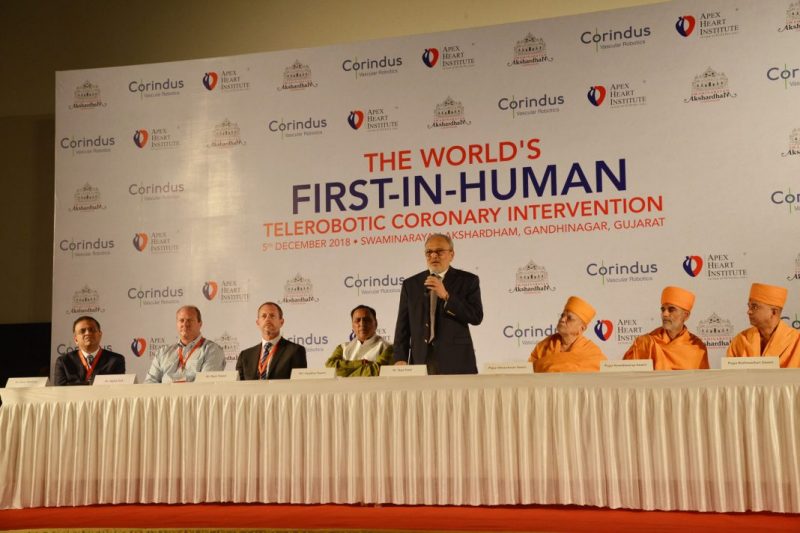





 telerobotic coronary intervention. This is the world’s First Percutaneous Coronary Intervention (PCI) conducted from a remote location outside of the catherization lab...………...)