













Enzyme VEGFR1 holds promise for advanced cancer treatments

IISER Kolkata researchers uncover the molecular mechanism of VEGFR1, opening avenues for colon and renal cancer therapies

0
119
New Delhi: Researchers have unlocked a molecular mechanism that could pave the way for novel treatments for colon and renal cancers. A cell surface receptor enzyme, VEGFR1, which belongs to a family of enzymes that bind growth factors and regulate various cellular processes, has been found to prevent cancer progression through a unique mechanism of autoinhibition.
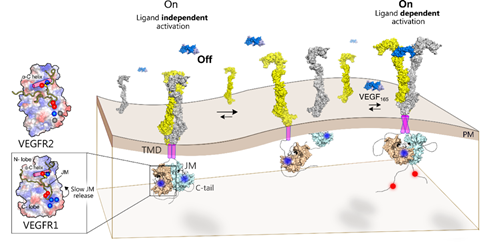
The study, conducted by the Indian Institute of Science Education and Research (IISER) in Kolkata, reveals that VEGFR1 remains autoinhibited, or self-suppressing, in the absence of specific ligands, such as hormones. Activation of VEGFR1 has been found to lead to cancer-associated pain, tumor cell survival in breast cancer, and migration of human colorectal cancer cells. This discovery suggests that molecules that stabilize the inactive state of VEGFR1 could potentially be used to develop medical solutions for these cancers. 
Receptor Tyrosine Kinases (RTKs) like VEGFR1 are essential for converting external chemical signals from growth factors into regulated cellular responses. Ligand binding to these receptors activates intracellular enzymes, which in turn trigger a cascade of cellular functions such as growth, development, and immune responses. When these receptors are spontaneously activated without their ligands, it can lead to various diseases, including cancers, diabetes, and autoimmune disorders. 
The VEGFR family of receptors is a key regulator in the generation of new blood vessels, a process known as angiogenesis. Angiogenesis is essential for functions such as embryonic development, wound healing, tissue regeneration, and tumor formation. By targeting VEGFRs, various malignant and non-malignant diseases can be treated.
The research highlights a key difference between two members of the VEGFR family: VEGFR1 and VEGFR2. While VEGFR2 can activate spontaneously and is a primary regulator of blood vessel formation, VEGFR1 remains inactive even when overexpressed in cells. VEGFR1 binds to its ligand, VEGF-A, with a ten-fold higher affinity than VEGFR2, but this binding only induces a transient activation of the kinase.
Dr. Rahul Das and his team at IISER Kolkata found that VEGFR1’s autoinhibited state is maintained by an ionic latch that uniquely stabilizes this receptor. This latch hooks the juxtamembrane segment onto the kinase domain, preventing spontaneous activation. The study also proposes that cellular tyrosine phosphatase plays a crucial role in modulating VEGFR1 activity.
This research, supported by DST-FIST and conducted at the Analytical Biology Facility at IISER Kolkata, suggests that targeting the autoinhibited state of VEGFR1 with small molecules could regulate pathological angiogenesis, the formation of new blood vessels that occurs in cancer. The findings, published in *Nature Communications*, indicate that these molecules hold potential for treating cancers such as colorectal carcinoma and renal cancer, where VEGFR1 is often overexpressed.
The discovery opens new avenues for therapeutic interventions against cancers driven by the spontaneous activation of VEGFR signalling, providing hope for more effective treatments for patients suffering from these aggressive cancers.