





























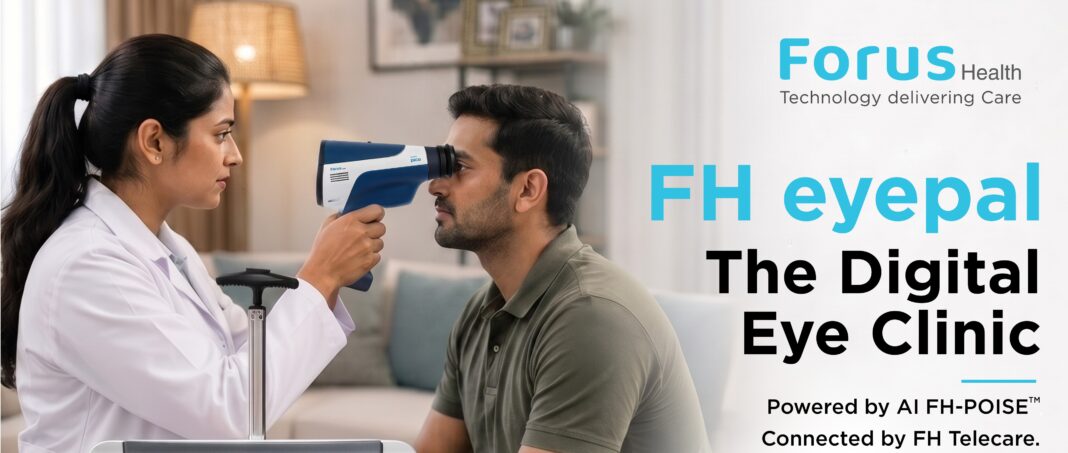
FH Eyepal integrates vision assessment, refraction, retinal imaging, artificial intelligence-assisted analysis and digital patient records for deployment beyond conventional eye clinics.
Medical technology company Forus Health has launched FH Eyepal, a portable connected eye-care platform designed to support vision screening, refraction and retinal imaging outside conventional hospital and clinic settings.
According to the company, the system can be deployed at primary healthcare centres, community screening programmes, corporate health initiatives, vision camps and home-based care settings.
FH Eyepal brings together handheld vision screening, objective refraction through an autorefractometer, subjective refraction using a digital wearable refractor and retinal imaging through a handheld fundus camera. The company said the integrated workflow can take patients from an initial vision assessment to spectacle prescription.
The system is connected to Forus Health’s digital-health platform, which creates a unified patient record and manages workflows through its FH TeleCare portal. The devices communicate through Bluetooth, which the company said allows parts of the workflow to continue in locations with inconsistent internet connectivity.
Retinal images captured through the system can be analysed using FH-POISE, Forus Health’s artificial intelligence platform. The company said the analysis is intended to flag potential abnormalities and assist healthcare providers in determining whether further clinical assessment or referral may be required.
“FH Eyepal is far more than a collection of advanced imaging devices. It is a fully integrated digital eye-care ecosystem that enables a complete eye clinic to be established virtually anywhere within minutes,” said K. Chandrasekhar, Co-founder and CEO, Forus Health.
Forus Health said it plans to work with eye hospitals, healthcare institutions and government organisations to deploy the platform in decentralised care settings.
Details concerning the system’s commercial availability, regulatory status, deployment sites and the specific clinical indications supported by its artificial intelligence modules were not provided in the announcement.