




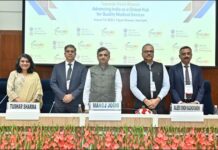
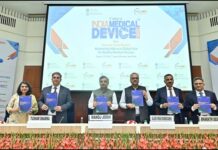
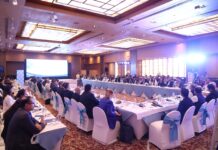














New Delhi: The online meeting “Addressing COVID Resurgence – S&T Perspective” organized by Technology Information, Forecasting and Assessment Council (TIFAC), an autonomous body of the Department of Science and Technology (DST) brought together scientists, doctors, drug manufacturers, industry and policymakers to brainstorm on ways to check the spread of the virus.
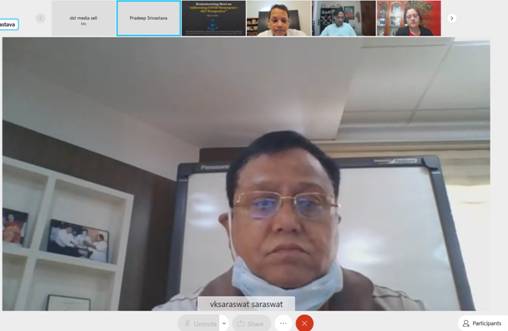
“There is a huge requirement of oxygen in the country with the supply chain not being robust, India is mostly dependant on other countries for critical equipment like oxygen concentrators. The S&T community along with Industrial partners has to find major means and ways to make sure our dependence is reduced. Vaccine production in the country is also dependant on raw materials from other countries hence there is a need for a major push on active pharmaceutical ingredients (API) to be produced in the country,” said Dr. V.K. Saraswat, Chairman- TIFAC Governing Council and Member NITI Aayog. “We have to focus on creating an S&T infrastructure for short-term training of the paramedics, doctors coming directly after MBBS for augmenting the preparedness of our Healthcare infrastructure,” he added.
Dr Saraswat emphasized on ramping up of research facilities particularly in genome sequencing, use of S&T methods like drones for supply & distribution of the vaccines and various drugs, use of technology like AI for facilitation & management of vaccine production and complete vaccination of India’s population to stop the spread of the virus. He also urged the panelists to come up with programs that give solutions to mitigate the immediate and mid-term problems.
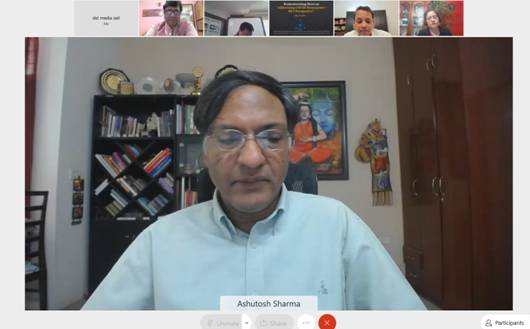
“Science, Technology, and Innovation are the central pillars to address the issues related to the second wave of COVID 19 and similar challenges of the future as well. There are several different components of S&T that are relevant for COVID-19 including Understanding of the behavior of the virus from its transmission to its impact; development of relevant Technology & Products; and Manufacturing at scale,” highlighted Prof. Ashutosh Sharma, Secretary DST. “All of these have to connect seamlessly. This is a major lesson that we already learned and implemented in the first wave and we must not forget it,” he added.
Prof Sharma said that there are other aspects of S&T which are equally important. These include well-researched White Papers for undertaking focused specific S&T interventions to be undertaken post-COVID 19. The one released by TIFAC has led to a number of follow-up actions in several sectors. “Other important activity is communicating about COVID 19, which is being done by Vigyan Prasar. Almost one COVID bulletin is disseminated through the India Science OTT Channel. TIFAC has also made a portal for immigrant labors and employees for matching of supply, demand, and required skills. Finally, mathematical modelling is a great tool for decision making, planning and governance, DST has supported 30 different groups across the country for the modeling activity and it would be taken forward in the future also,” he added.
Dr. Vijay Chauthaiwale, Healthcare Consultant in his address mentioned “Any pandemic can be evaluated and contained at three levels which are Diagnosis, Prevention and Therapy or treatment. The second wave has shown our deficiencies as well as strength of our society in all these three aspects. Therefore, we need to analyse them a little bit deeper. The picture on the vaccine front will turn significantly better in coming weeks with enhanced supply from both the existing suppliers as well as the new players like SPUTNIK, Zydus Cadila and others coming in.”