







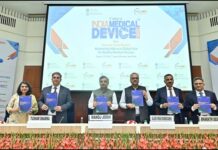





















New Delhi: Qure.ai unveiled its latest report, ‘AI in Action: Transforming Health Outcomes Across India’s Care Spectrum’, at the India AI Impact Summit.
The event outlined how artificial intelligence is being deployed at scale across India’s public healthcare system to address critical challenges such as tuberculosis, lung cancer, and acute neurological conditions.
The report consolidates real-world evidence from large public health programmes, state-wide deployments, and multi-country clinical studies, demonstrating how AI, when embedded into existing healthcare workflows, can accelerate diagnosis, reduce system-level delays, and improve access to timely care without adding cost or operational complexity for patients or providers.
Central to the report is the role of state-level partnerships in enabling AI adoption at population scale. Across Maharashtra, Karnataka, Goa, Punjab and other states, governments and public health agencies have integrated AI into routine imaging and emergency care pathways to strengthen detection, triage and follow-up.
-
In Maharashtra, AI-enabled incidental screening across public and private facilities contributed to an estimated 35% increase in tuberculosis detection, including among asymptomatic patients undergoing X-rays for unrelated reasons.
-
In Karnataka, a government-led partnership enabled the incidental detection of over 6,400 TB casesalongside high-risk lung nodules through a single AI-driven workflow.
-
In Goa, a statewide public health deployment screened over one lakh routine chest X-rays, leading to 20 confirmed lung cancer diagnosesthrough structured referral pathways.
-
In Punjab, a state-supported hub-and-spoke stroke network reduced diagnostic turnaround time by up to 85%, protecting the critical “golden hour” even in district hospitals.