






Union Health Minister emphasizes Universal Health Coverage in India at WHO Regional Committee Session

JP Nadda announces significant expansions in health schemes, including coverage for 120 million families and enhanced support for NCDs

0
211
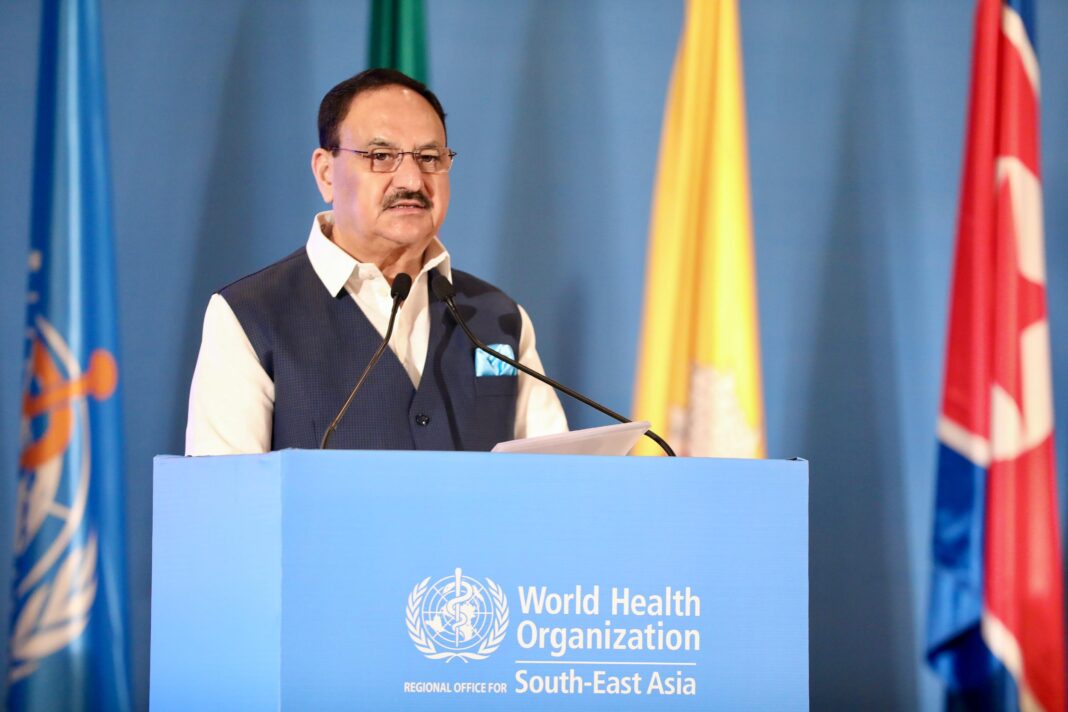
New Delhi: Union Health Minister Jagat Prakash Nadda highlighted India’s commitment to achieving Universal Health Coverage (UHC) through a comprehensive ‘whole of government’ and ‘whole of society’ approach during his inaugural address at the 77th session of the World Health Organization (WHO) Southeast Asia Region Committee. 
The Regional Committee meeting commenced with the selection of officials, formation of a “Drafting Group for Resolutions and Decisions,” implementation of “Special Procedures” to govern the proceedings, and approval of the provisional Agenda.
Speaking at the event, he emphasized the importance of strengthening primary healthcare and essential services as foundational pillars of this initiative. Nadda noted, “In line with the commitment to provide health cover for all, the Union Government launched the world’s largest publicly funded health assurance scheme, the Ayushman Bharat Pradhan Mantri – Jan Arogya Yojana (AB PM-JAY). This initiative covers over 120 million families, providing an annual hospitalization benefit of USD 6,000 per family.” 
He highlighted that the government has recently expanded the scheme to all citizens aged 70 years and above. “This expansion will benefit around 45 million families, including 60 million elderly population, by providing them free health insurance coverage. It underscores the government’s commitment to ensuring universal and inclusive healthcare for India’s growing elderly demographic”, he said.
The Union Health Minister also addressed the escalating public health challenges posed by non-communicable diseases (NCDs), sharing, “India is implementing the National Programme for Prevention and Control of NCDs since 2010 to address conditions such as hypertension, diabetes and cardiovascular diseases. This initiative has led to the establishment of 753 NCD clinics, 356 Day Care Centers, and 6,238 Community Health Centers to focus on preventive measures at an early stage.”
Highlighting India’s role as a leader in the digital health landscape, Nadda announced plans to share its Digital Public Infrastructure (DPI), including initiatives like the Ayushman Bharat Digital Mission and e-Sanjeevani. He indicated that these tools would be provided alongside technical and financial support through the WHO-managed Global Initiative on Digital Health, launched during India’s G20 Presidency. Following the success of the CoWIN digital platform during the COVID-19 pandemic, India has also developed UWIN, an online platform to monitor vaccination events under the Universal Immunization Programme.
Nadda stressed the significance of integrating traditional and complementary medicine into the health system, supporting WHO’s initiative to create a Global Traditional Medicine Centre. He cited, “India’s experience in integrating this system with the conventional system of medicine has led to the provision of holistic healthcare, promoting overall well-being and expanding the range of healthcare services.” 
“Our Ayushman Aarogya Mandirs that are community Health & Wellness Centres are significant in providing comprehensive healthcare through both traditional and conventional systems of medicines, ensuring the physical and mental well-being of our citizens”, he noted.
In closing, Nadda reiterated Prime Minister Narendra Modi’s vision of ‘Sabka Saath, Sabka Vikas, Sabka Vishwas, Sabka Prayas,’ which promotes inclusive development and trust among nations. He called for collective experiences to drive transformative actions across countries, asserting that health transcends borders and requires a collaborative approach. “By learning from each other’s successes and challenges, we can enhance the resilience of health systems,” he concluded.
Saima Wazed, Regional Director of WHO SEARO, remarked on the remarkable progress made since the formation of the regional committee in 1948, yet emphasized the new challenges, including antimicrobial resistance, that need to be addressed with collective wisdom and contemporary tools.
Present at the event were Punya Salila Srivastava, Union Health Secretary; Hekali Zhimomi, Addl. Secretary, Health Ministry; Aradhana Patnaik, Addl. Secretary, Health Ministry; Dr. Rodrigo Offrin, WHO Representative to India and other key figures from the WHO and Indian health ministry officials, underscoring the collaborative spirit that defines India’s healthcare initiatives on the global stage.